



Transportation Performance Targets

Channel district intersection, people walking, bus picking up passengers

The Hillsborough TPO uses performance measures to inform and guide its policy, planning, and programming activities. Selecting meaningful system performance measures facilitates transparency in the prioritization process and informs key funding decisions.

Federal Performance Targets

The Hillsborough TPO uses performance measures to inform and guide its policy, planning, and programming activities. Selecting meaningful system performance measures facilitates transparency in the prioritization process and informs funding decisions.

Originally under Moving Ahead for Progress in the 21st Century (MAP-21) Act, and now under the Bipartisan Infrastructure Law, performance measures are intended to guide investment toward the achievement of goals for Safety (PM1), Infrastructure Condition (PM2), System Performance (Reliability) (PM3), Transit Asset Management (TAM), and Public Transportation Agency Safety.

This fact sheet provided by FDOT outlines state and MPO expectations.

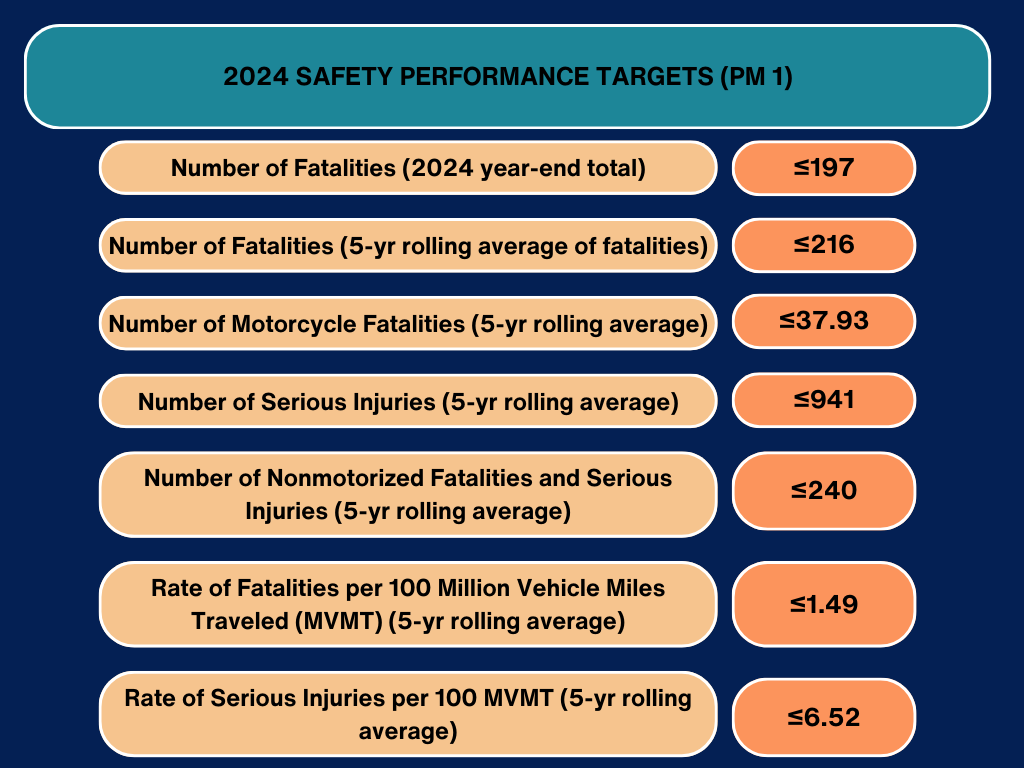
Adopted annually, the safety performance measures, also known as PM 1, evaluate several key measures in safety planning. FHWA requires five measures, while the number of fatalities and the number of motorcycle fatalities on a five-year average on Hillsborough TPO-elected.

Key definitions:
100M VMT: 100 million vehicle miles traveled. The total number of miles a motor vehicle travels in a region over a specific period.

Serious (incapacitating injury): a significant injury that causes permanent damage or loss of bodily function.

Nonmotorized: bicyclist or pedestrian

Performance Measure2025 Target
Fatalities≤147
Fatalities (5yr)≤185
Fatalities per 100 MVMT (5yr)≤1.16
Motorcycle Fatalities (5yr)≤37
Serious Injuries (5yr)≤891
Serious Injuries per 100 MVMT (5yr)≤5.55
Nonmotorized Fatalities & Injuries (5yr)≤228

Adopted January 2026

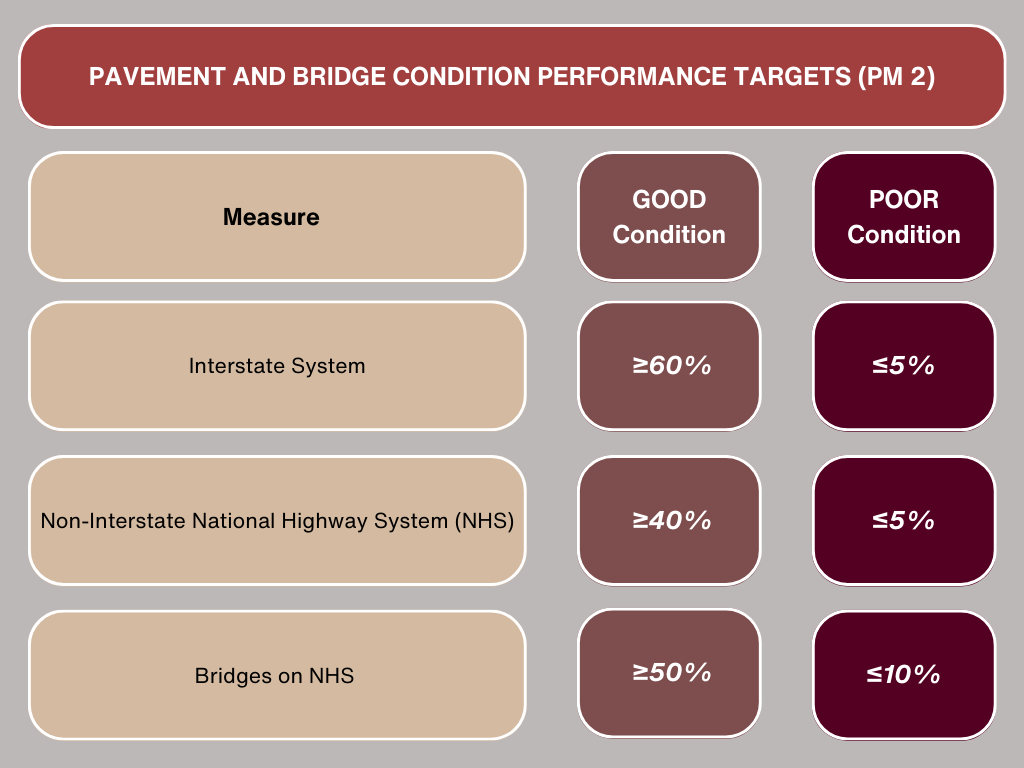
The bridge and pavement condition category, or PM 2, is updated every 4 years and can be revised every 2 years. It measures the percentage of bridges and pavement on the National Highway System (NHS) in good and poor condition.

The National Bridge Inventory (NBI) data is used to calculate bridge conditions, which include deck, superstructure, substructure, and culvert quality. Please note that the bridge condition score does not equal the structure’s safety.

Pavement condition is measured based on the type of material used. The International Roughness Index (IRI), rutting, and cracking percentage are used for asphalt. For jointed concrete pavement: IRI, faulting, and cracking percentage. Continuously reinforced concrete pavement: IRI and cracking percentage.

Bridge Condition

Performance MetricTarget
% of NHS bridges (by deck area) in GOOD condition71.3%
% of NHS bridges (by deck area) in POOR condition0.0%

Adopted April 2023 and Renewed March 2025

Pavement Condition

Performance MetricTarget
% of Interstate NHS Pavements in GOOD condition69.9%
% of Interstate NHS Pavements in POOR condition0.7%
% of non-Interstate NHS Pavements in GOOD condition46.4%
% of non-Interstate NHS Pavements in POOR condition1.2%

Adopted April 2023 and Renewed March 2025

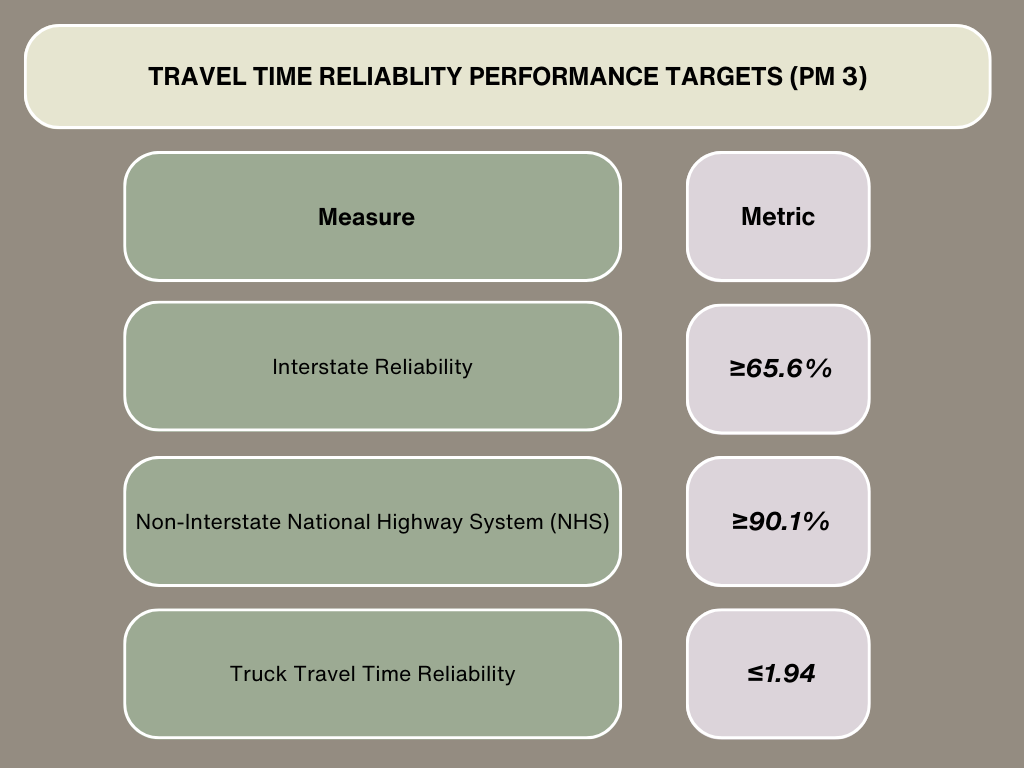
System performance, commonly referred to as PM 3, assesses Travel Time Reliability (TTR) on the National Highway System (NHS). TTR reflects the consistency of travel times, measured on a day-to-day basis and across different times. It is favored as a more meaningful metric than other congestion indicators. While we have limited ability to decrease traffic volumes, we can implement improvements to traffic flow. In essence, while we may not be able to reduce the number of cars on the road, we can utilize transportation projects to enhance movement.

Level of Travel Time Reliability (LOTTR) shows how dependable travel times are on our roads. It compares longer travel times, known as the 80th percentile, to typical travel times, which are the 50th percentile. This data comes from the Federal Highway Administration.

They collect information every 15 minutes from 6 a.m. to 8 p.m. on important roadways. LOTTR tells us what percentage of miles traveled on these roads are reliable. This includes all types of road users, such as passengers in buses, cars, and trucks.

Performance MetricTarget
Interstate NHS Reliability≥65.6%
Non-Interstate NHS Reliability≥90.1%
Truck Reliability≤1.94

Adopted April 2023 and Renewed March 2025

Transit Asset Management (TAM) (PM 4) is a strategic approach focused on maintaining and improving public transportation assets. Federal regulations define “State of Good Repair” and mandate that entities like the Hillsborough Area Regional Transit Authority (HART) develop a TAM plan. Additionally, MPOs are required to report their targets with each update of the Long Range Transportation Plan (LRTP).

TAM measures the useful life benchmark (ULB) for equipment and rolling stock, track segments with performance restrictions, and facilities rated below three on the Transit Economic Requirement (TERM) scale.

EquipmentAutomobiles72.97%
Trucks and other Rubber Tire Vehicles14.29%
Rolling StockBus28.4%
Cutaway0%
Streetcar Vehicle11.11%
FacilitiesPassenger/ Parking Facilities10%
Administrative/ Maintenance Facilities20%
InfrastructureStreetcar Rail0%

Adopted August 2024

Public Transportation Agency Safety Plan (PTASP) refers to a federal regulation that mandates public transportation agencies receiving federal funding to develop and implement comprehensive safety plans. These plans must include processes for managing safety risks and require the establishment of safety targets. The TPO may adopt these targets or set them independently with each update of the LRTP.

In the TPO planning area, HART is the sole tier 1 provider, leading the TPO to adopt HART’s targets in 2026.

Fatalities Fatality Rate*InjuriesInjury Rate*Safety Events**Safety Events Rate*System Reliability***
Bus00250.38180.279,748
Demand Response0010.0630.1716,547
Streetcar0000.0080.659,419

Adopted January 2026

*rates are calculated as the target number of events divided by 100k Vehicle Revenue Miles
**collisions, derailments, fires, hazardous material spills, evacuations
***miles between major mechanical failures

State of the System Reports

The State of the System (SOS) has been publishing reports since 2016, covering performance measures such as safety, pavement and bridge condition, and system performance. These reports have been influential in guiding performance-based planning for the TPO Board and as a guide for other MPOs across the State. The SOS was updated in 2018 to include additional factors such as transportation equity, air quality, and multimodal accessibility. In 2022, the Transportation Planning Organization (TPO) Board approved the 2021 State of the System Report, and the most recent report, the 2024 State of the System Report, was approved in May 2024, focusing on transit and multimodal access.

All State of the System reports are available in the Plan Hillsborough Digital Library, with the 2024 SOS report specifically accessible on the current Plan Hillsborough page.

Other Resources